

ProcellaRX Calls on Life Sciences to Reinvent Digital Validation: A Vision for 2030
Reinvention Lab 2030

Dori Gonzalez-Acevedo, Founder and CEO
ProcellaRX
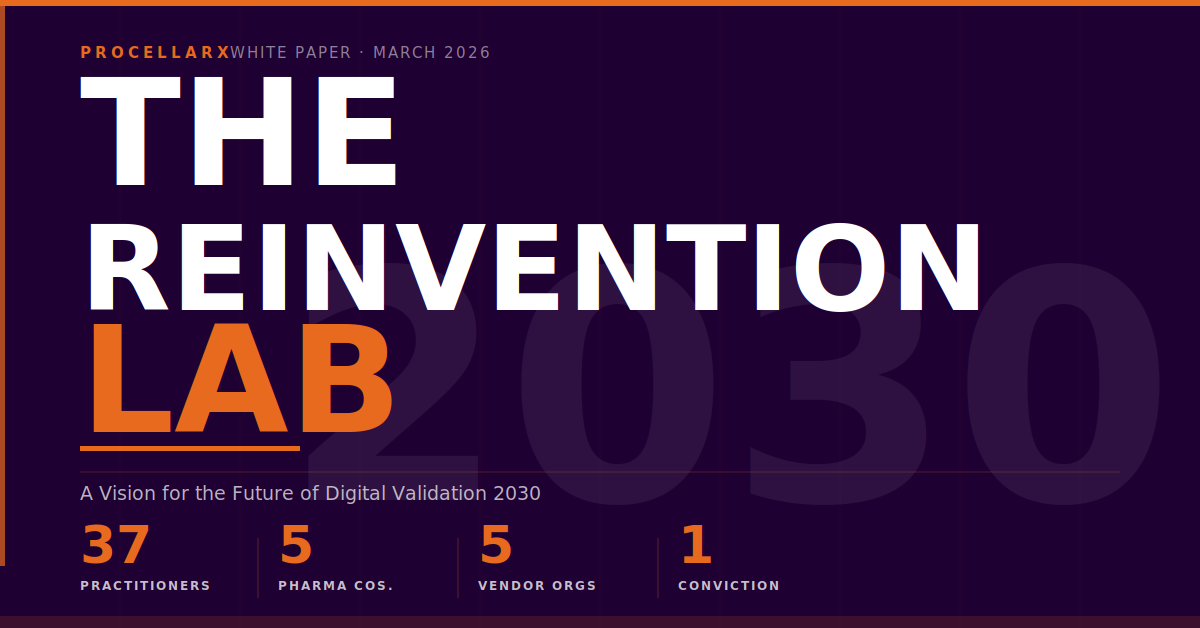
37 practitioners. 5 pharma companies. One shared conviction: legacy computerized system validation no longer serves the industry it was built to protect
The validation framework that protected patients for decades was built for a world that no longer exists. The Reinvention Lab was built to close that gap, together.”
ALEXANDRIA, VA, UNITED STATES, March 26, 2026 /EINPresswire.com/ -- ProcellaRX, LLC today released "The Reinvention Lab: A Vision for the Future of Digital Validation 2030," a collaborative white paper representing the collective output of 37 pharmaceutical industry practitioners convened at the North Carolina Biotechnology Center in Research Triangle Park in October 2025. The paper issues a direct challenge to legacy computerized system validation (CSV) practices and presents a pragmatic, evidence-backed framework for transforming how regulated life sciences organizations generate, govern, and demonstrate assurance.— Dori Gonzalez-Acevedo
The white paper arrives at a moment of decisive regulatory convergence. The U.S. Food and Drug Administration finalized its Computer Software Assurance (CSA) guidance in September 2025, subsequently updated in February 2026, endorsing exploratory testing, continuous monitoring, and the use of supplier evidence. The International Society for Pharmaceutical Engineering (ISPE) published its Digital Validation Guide and AI Maturity Model in 2025, providing structured frameworks for scaling validation effort based on system risk and autonomy. The European Medicines Agency released its Guideline on Artificial Intelligence in Medicinal Product Development in December 2025. PIC/S issued updated guidance on Good Practices for Data Management and Integrity in January 2026. Taken together, these publications mark a clear regulatory signal across jurisdictions: risk-based, least-burdensome assurance is not only acceptable — it is the preferred path forward.
About the White Paper
The Reinvention Lab was convened as a one-day working forum — not a conference — on October 24, 2025. Participants represented a functional cross-section of engineering, CSV, product management, regulatory affairs, and quality across pharmaceutical and vendor organizations, including contributors from Gilead Sciences, Parexel, United Therapeutics, Melillo Consulting, Kneat, Perforce, Valkit.ai, and GenariAI, among others. The forum replaced slide decks with whiteboards, debate with disciplined conversation, and lectures with hands-on collaboration — producing a consensus-backed action plan grounded in operational reality, not theoretical frameworks.
The paper identifies four systemic challenges driving the need for reinvention. First, compliance practices remain documentation-heavy and insight-light: organizations produce thousands of pages of test scripts and traceability matrices, yet the connection between that burden and actual patient safety is rarely interrogated. Second, SDLC management, testing, risk assessment, change control, and document management operate as disconnected workflows, producing redundant data entry, inconsistent risk assessments, and audit preparation that consumes hundreds of hours reconstructing evidence that should have been captured automatically. Third, many organizations remain anchored to practices designed for early GAMP paradigms, widening the gap between regulatory intent and operational execution. Fourth, when quality is framed primarily as inspection defense, it loses its strategic potential to accelerate time-to-market, reduce rework, and improve decision quality.
The paper organizes its response around five strategic impact areas. In Reinventing Validation Models, it calls for risk-based, digital-first assurance scaled to intended use and criticality — fully aligned with the FDA's CSA guidance and GAMP 5 Second Edition — targeting a 50–60% reduction in end-to-end validation cycle time while maintaining or improving audit readiness and defect detection rates. On AI and Trust, the paper provides a framework for operationalizing explainable AI in quality workflows, including risk triage, test selection, and evidence grading, with documented controls for bias detection, performance monitoring, and human escalation in GxP environments. Culture and Leadership of Quality addresses the structural gap in how the industry develops and incentivizes its quality workforce, calling for realigned decision rights, behaviors, and performance metrics that reward assurance outcomes rather than documentation volume. Systems and Interoperability targets the integration of disconnected quality workflows into a single-source evidence architecture with automated audit trails and API-first integrations, setting a target of 70% or greater reduction in duplicated data entry and 50% reduction in audit preparation hours. Collaboration and Standards addresses the industry-wide waste of redundant validation effort, distinguishing between fit-for-purpose validation — demonstrable by vendors once for all customers — and fit-for-use validation, which each regulated entity must demonstrate for its specific operational context.
"Paper remains the primary validation tool. The shift to digital is not simply a change in medium — it requires a fundamental change in mindset."
— Stephen Ferrell, Chief Product Officer, Valkit.ai
The paper also presents a phased roadmap from 2026 to 2030. The near-term phase, spanning one to two years, focuses on publishing the Reinvention Lab Manifesto, launching three to five proof-of-value pilots across pharma, biotech, and medical device sectors, and deploying early AI-assisted use cases with minimal viable governance controls. The mid-term phase scales integrations across SDLC and GRC platforms, retires duplicative process steps, establishes industry benchmarks, and co-develops position statements with ISPE, ASQ, and SQA. By 2030, the vision is for digital validation to be the recognized industry default, with ProcellaRX's frameworks contributing to an industry-recognized reference model and measurable, published gains in cost, speed, and quality across dozens of organizations.
The paper also addresses the risks of this transition with equal candor — including the danger that "risk-based" becomes "risk-rationalized" in organizations with weak assessment capabilities, that AI bias escapes detection in insufficiently monitored workflows, and that new tools layered over unchanged cultures produce validation theater rather than genuine transformation.
Availability
The Reinvention Lab white paper is available at no cost at www.procellarx.co and www.reinventionlab.co. ProcellaRX invites quality leaders, validation engineers, technology partners, and regulatory professionals to download the paper, engage with the Reinvention Lab community, and participate in proof-of-value pilots launching in 2026.
Dori Gonzalez-Acevedo
ProcellaRX
+1 484-433-7531
dgacevedo@procellarx.co
Legal Disclaimer:
EIN Presswire provides this news content "as is" without warranty of any kind. We do not accept any responsibility or liability for the accuracy, content, images, videos, licenses, completeness, legality, or reliability of the information contained in this article. If you have any complaints or copyright issues related to this article, kindly contact the author above.
