

AI.cc Expands Unified API Platform with Access to 400+ AI Models to Help Enterprises Reduce Costs by Up to 80% in 2026
This launch allows developers and enterprises to integrate top models from OpenAI (including GPT-5.4 series), Anthropic (Claude 4.5 Opus), Google (Gemini 3), xAI (Grok), DeepSeek, Alibaba Qwen, ByteDance, and many specialized providers — all without rewriting code or managing multiple integrations.
The Growing Challenge of Multi-Model AI Integration
As AI models evolve rapidly, organizations often need to use different providers for optimal performance: premium reasoning models for complex tasks, faster or cheaper options for high-volume workloads, and specialized models for image, video, voice, or 3D generation.
Traditional approaches require maintaining separate API keys, SDKs, authentication flows, rate limits, and billing systems. This leads to increased development time, higher maintenance overhead, potential downtime during peak usage, and difficulty in dynamically selecting the best model for each request.
AI.cc’s Simple Unified API Solution
AI.cc (www.ai.cc) solves this with a clean “One API” approach. Developers only need to change the base URL in their existing OpenAI-compatible code to https://api.ai.cc (or /v1) and use their AI.cc API key. Everything else — request format, response structure, and tool-calling — remains identical to the familiar OpenAI interface.
Key API features include:
Access to 400+ models covering chat/completion, image generation, video, music, 3D, voice, embeddings, and more. New models are added quickly as they become available.
Serverless architecture delivering low latency, high concurrency, and unlimited scalability without infrastructure management.
Intelligent routing that lets applications automatically or manually select the most suitable model based on task, cost, or performance needs.
Unified billing and dashboard for real-time usage monitoring, cost tracking, and management across all models.
High availability with robust rate limits designed for enterprise-scale workloads.
By consolidating access and leveraging optimized procurement, the platform enables enterprises to achieve up to 80% reduction in AI operational costs compared to direct vendor usage, depending on volume and routing strategy.
How the Unified API Works in Practice
Integration is straightforward. Here is a basic example using the popular OpenAI Python SDK:
Pythonfrom openai import OpenAI
client = OpenAI(
base_url="https://api.ai.cc/v1",
api_key="your_ai_cc_api_key"
)
response = client.chat.completions.create(
model="claude-4.5-opus", # or "gpt-5.4-pro", "gemini-3-pro", etc.
messages=[{"role": "user", "content": "Explain unified AI APIs"}]
)
print(response.choices[0].message.content)
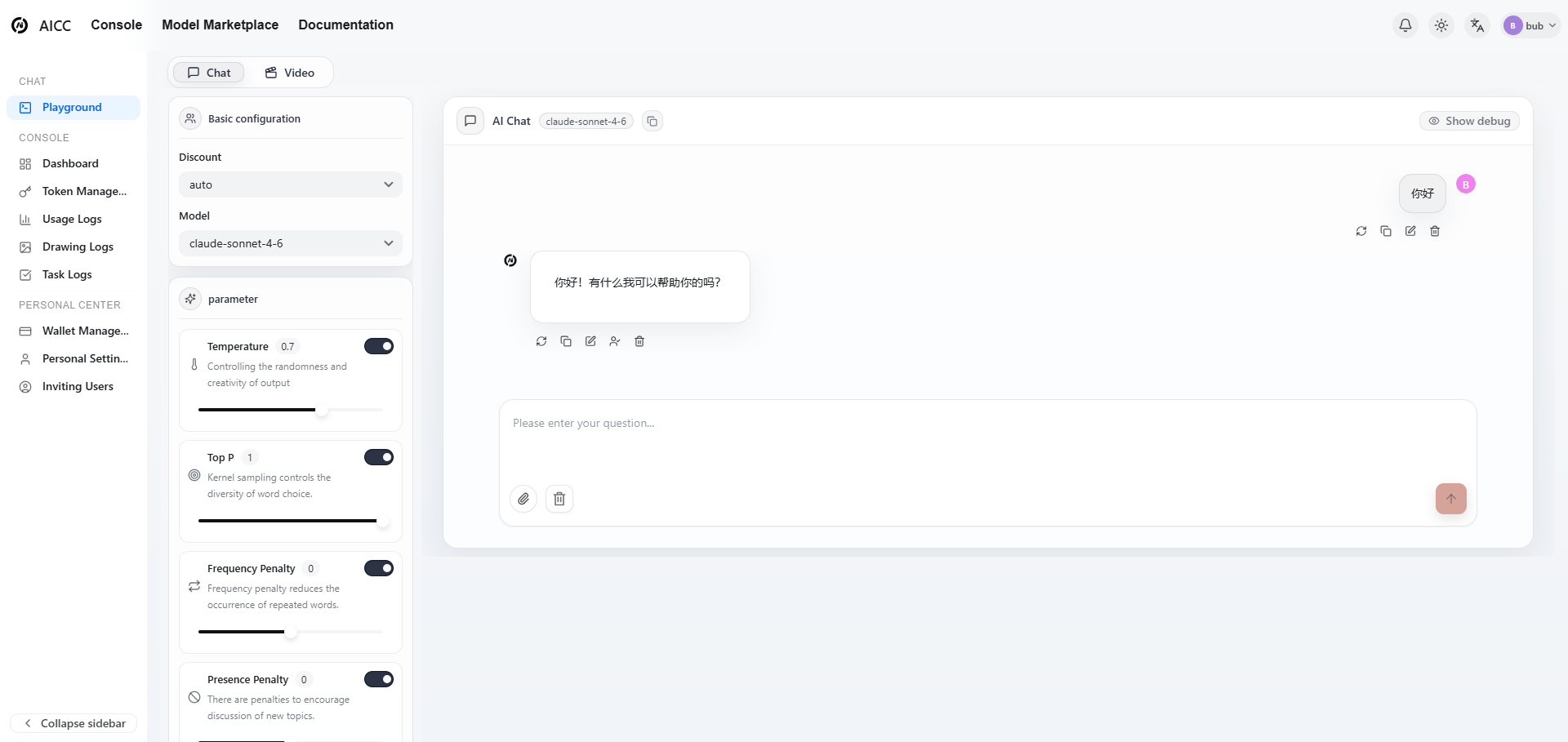
Switching between models is as simple as changing the model parameter. Teams can test different models side-by-side in AI.cc’s built-in Playground before deploying to production.
Benefits for Enterprise AI Development
Enterprises using the AI.cc unified API report:
Significantly reduced integration and maintenance time
Greater flexibility to experiment with the latest models without vendor lock-in
Improved cost efficiency through smart model selection (e.g., using high-performance models only when needed)
Easier scaling of AI agents and multi-step workflows that combine multiple model capabilities
The platform supports both simple chat applications and advanced use cases such as autonomous AI agents that dynamically route tasks across different models.
Comparison: Traditional Approach vs. AI.cc Unified API
Number of Endpoints: Multiple (one per provider) vs. Single unified endpoint
Code Changes for New Models: Significant refactoring vs. Just update model name
Management Overhead: Separate keys, billing, dashboards vs. Unified key and dashboard
Scalability: Constrained by individual provider limits vs. High concurrency & serverless
Cost Optimization: Limited vs. Up to 80% savings via routing and pooling
Getting Started with AI.cc API
Developers and enterprises can sign up at www.ai.cc to get a free API key and starter tokens. Full documentation, code examples, and model lists are available to make onboarding fast.
As AI becomes central to business operations in 2026, a unified API approach helps teams stay agile, control costs, and focus on building innovative applications rather than managing infrastructure.
For more details on the API and available models, visit https://www.ai.cc or explore the documentation at https://docs.ai.cc.
About AI.cc
AI.cc is a unified AI API platform based in Singapore that aggregates hundreds of leading AI models into one high-performance, developer-friendly interface.
This is a sponsored news release distributed on behalf of AI.cc.
AICC
AICC
+44 7716 940759
support@ai.cc
Legal Disclaimer:
EIN Presswire provides this news content "as is" without warranty of any kind. We do not accept any responsibility or liability for the accuracy, content, images, videos, licenses, completeness, legality, or reliability of the information contained in this article. If you have any complaints or copyright issues related to this article, kindly contact the author above.
